Cardless Cash Withdrawl
Visa and MasterCard Killer–Rupay
TOI reports that India will soon have it’s own payment processing firm called Rupay competing with Visa and Mastercard payment processing firms.
After almost two years of planning, the National Payments Corporation has at last finalised the proposed unique India Card which once commercially launched would be an domestic alternative to the global real-time payment processing firms like Visa andMasterCard.
"We have finalised name of the proposed card as Rupay at our board meeting here today. We have also finalised the logo for the same," a senior official of the RBI-set up National Payments Corporation of India (NPCI), told PTI this evening. The official sought not to be named.
NPCI is an umbrella institution for all the retail payment systems in India. I could not find any information about Rupay on the NPCI website, but given the statistics of the transactions that it handles is pretty impressive. It also gives a list of Payment systems worldwide, which is interesting to know.
The advantages of Rupay should be really good especially in lowering the transaction charges for using debit/credit card at merchant sites. As of now, all the banks which issue credit or debit cards to the end-user for transactions at various merchants in India or abroad has to tie up with Visa or Mastercard. The transaction is routed through the infrastructure owned by Visa/Mastercard not situated within the country. This implies substantial cost to the banks as well as merchants which are passed on to the end customer. Rupay will eliminate majority of this cost.
The interchange cost for transaction settlement paid by Indian banks to Visa/Mastercard is close to Rs 500 crore in one year and most of these transactions are purely domestic transactions. Rupay would reduce this cost substantially and can still connect to the Visa/Mastercard for international transactions.
The plan is great, but it needs solid execution, since any Rupay based system has to develop the necessary infrastructure to handle the millions of transactions that happen in India. Also security is a big concern and Rupay need to scale up quickly to the level of Visa/Mastercard to ensure transactions in secure manner with less chances of fraud. In case of Visa/Mastercard they push the security solutions based on their standard up-gradation worldwide. So Rupay system need to match that as be as agile in upgrading to latest security infrastructure as happens globally. It is also a challenge to incentivise the already existing merchants to sign up for the Rupay system. Ofcourse cost advantage will help but security will be the key. NCPI has loads of work to do on that front.
The NCPI is also working on utilizing the Aadhaar developed by UIDAI (headed by Nandan Nilekani) and will be developing a proof of concepts through a MicroATM. This is interesting since it brings the lowest strata of society into high-technology banking transactions.
Web Hosting Fraud and how to be cautious!!
I have been mulling over moving this blog to a self hosted website. The thought came to me after seeing many awesome blogs as self hosted (like chandoo or tipguy blogs). The flexibility and control provided by self-hosting is immense (see 10 reasons to self-host a blog) and I felt it could be like moving one step further in terms of my blogging interests. Although there are people who are very popular online without any self-hosting blog (Rashmi or Rohit) but for me I thought let me research a bit on self-hosting before I move this blog.
So I started searching and found a super beginner’s guide for starting your own website. I realized that essentially I need two things:
- A Domain Name [Similar to say Company Name]
- A Web-Hosting Subscription [Similar to Office Space for rent]
I searched and found that there are literally millions of companies providing both the services with variety of choices, options, features, claims and rates. Also to confuse you further there are several websites providing the top 10 web hosting company lists. And after reading so many websites on how to choose the web-hosting companies if you could manage to choose some company, and if you search about the review of that specific company, you will find that there are equal number of positive and negative review comments, leaving you totally exasperated.
But the worst is yet to come. After all this (apart from sending emails to some folks like chandoo or find who-is information about popular self hosted blogs), I zeroed on to BlueHost web hosting company. I ignored the review comments and focussed on least price hosting company (I felt like gambling and thought let me taste the world of self-hosting). The one thing good about BlueHost is that they give the domain name registration free and the domain name is registered in your name. A lot of companies cheat by registering domain name in their name and then it is difficult for the customer to move away from them. Imagine you want to start a company and when you ask an agent to register the company, he did register in his name rather than yours. It amounts to blatant cheating, but who reads the “Terms and Conditions”.
One such cheating I came across when I tries to sign-up with the BlueHost company. Before I entered the credit card details, I decided to click on Terms and Conditions.
I was shocked to realize that once I enter the credit card details, the BlueHost can charge me on recurring basis unless I go and tell them not to charge. The terms indicate that all responsibility lies with me and they are legally free to charge me, if I fail to inform them that I no longer want their services.
When I searched the other hosting options, every single provider has the same mechanism, which virtually ensures that you stay with them forever. A recurring payment (also known as a 'continuous payment authority') is an automatic regular payment which is set up using your debit or credit card.
The biggest problem with recurring payments is that only the company can stop the recurring payment and you can not. So if you have to stop the payment, the onus is on you to convince the company to stop the payment. The company may put additional conditions or charges for cancellation of such recurring services. The worse is that sometimes it may not be easy for you to get the company to cancel the recurring payment.
The other aspect of recurring payment is that the company keeps your credit or debit card information on their systems for charging in recurring fashion. This may lead to privacy issues
BTW, if you think you are smart ass and can cancel the credit card to prevent the recurring charges you are wrong, since that makes you liable for legal charges by the company whom you have authorised for this recurring charge. Also if you try to tell the bank to stop payment to the company, bank will only act if you can prove that you did not authorise the company and it is a fraud. In any other case bank is obliged to honour the recurring credit card charges.
The only option for you is to work through the company by going through the cancellation policy that you probably did not read while signing up.
The one option that I think can work is to use virtual credit card (for e.g. HDFC NetSafe) which allows to create a virtual credit card with a chosen limit and validity. The other option is to use a pre-loaded card for such transactions which has a limit of transaction that you have pre-loaded. But be aware that this does not free you from the legal binding about accepting the recurring payment. It only ensures that the company has to chase you for the next recurring payment and not you to stop that recurring payment.
My Advice: Whenever using credit card (typically online), ensure to read “Terms and Conditions” specifically looking for recurring payment and cancellation policy.
As for my self-hosting journey, I need to find a company who will accept just a one time payment and do not force me to enter a recurring payment mode.
Best time for car buying is, now !!
I recently went for a car upgrade and realized that “now” is the best time to buy or upgrade your car. If you have been thinking about buying a new car or even upgrading your existing car or even buying a second hand car, Dec – 08 probably is a bonanza month for getting a handsome deal.
Here are some of the reasons why December this year is better:
Dealer Discounts: December is the month, when car sales usually drop. A typical consumer wants to buy a car in Jan since that changes the model year of the vehicle in expectations of higher re-sale value. This year due to the economic downturn, the car sales have already hit badly, hence dealers are trying to push sales aggressively to reduce the inventory. So you can expect huge discounts on all ranges of cars.
Government Fiscal Stimulus Package : To provide some boost to the automobile sector which is hit by falling sales this year, government has announced a 4% excise duty cut. As per reports :
Maruti Suzuki India (MSI), the country’s largest car maker, announced it was cutting prices effective from midnight. “We are looking at passing on the entire benefit to the customers. We shall be cutting down prices in the range of 3.5-4% from midnight and most of our vehicles will be cheaper by that percentage,” MSI chairman R C Bhargava said.
This again brings huge benefit to the ultimate consumers.
Ease of Auto-Loan : With government trying to bring the repo rate down to ease liquidity crunch with the banks, it becomes easier for banks to provide auto-loans.
Whenever the banks have any shortage of funds they can borrow it from RBI. Repo rate is the rate at which our banks borrow rupees from RBI. A reduction in the repo rate will help banks to get money at a cheaper rate. When the repo rate increases borrowing from RBI becomes more expensive.
This can bring the auto-loan rate by 1-2% and makes the loan easier on the consumer pockets.
When I walked into the Sagar Automobiles (Maruti showroom on B.G. Road), I realized that almost all vehicle prices are down by a huge amount. For example, a typical WagonR Lxi which was priced at around 4.1 lakhs on road, now coming at 3.6 lakhs on road. If you already own a maruti vehicle and want to upgrade you can bargain for more discounts. Also the loans are coming cheaper with SBI giving a loan at 11.75-12%, while private banks at around 13% (which might be reducing further). BTW another reason to cheer while buying a car is the reduction in petrol prices. Also there is talk of privatizing the petroleum products (Petrol and Diesel), and if that happens, the prices are about to fall further. Consumer is the king for now!!
10 Tips to protect credit card fraud
A merchant has to verify the signature on the back of the card with that on the purchase transaction slip. Some merchants fails to do that, but putting your signature on the back of the credit card can minimize the mis-use.
Tip #2 Do not use your credit card for Online shopping from a public computer
This has been time again mentioned in various magazines/blogs/websites, but it still remain the single most important loophole, which causes significant mis-use of the credit card. To add an extra security measure I always use credit card from my home computer and not even office computer.
Tip #3 Always make sure to use secure http connection. The URL should contain https and seeing that a lock symbol is at the bottom corner of a website.
Tip #4 Mark the CVV number (last three digits at the back of the card) illegible by ink and remember it either in your head or keep it secretly at your home.
Tip#5 If you credit card bank provide some mechanism to create virtual cards (like HDFC's Netbanking OR Axis's eShop Card) use that facility.
Tip#6 Get a credit card issued with a very small limit
With disposable income rising and the mentality of credit card companies to provide exhorbitantly high credit limits (sometimes 2-3 times monthly salary or even more), it is no longer surprising that if you try to get a credit card, the limit would be several lakhs. It will be a big blow if such a high value card is mis-used. I have a citibank credit card with a limit of 20K (this was 5K when I was in IIT as a student). I have consistenly "thwarted" citibank's ploy to increase the credit limit. This credit card is of immense use to me and I mostly use the card for my daily purpose. I dont live in fear since the maximum misuse that can be done is (20K - outstanding balance) at any given time. If you dont have a card, ask the company to issue a card to your non-working spouse OR your child (Not an add-on card).
Another way is to push the company to reduce the credit limit. I have done this for my wife's credit card (whose initial limit was 1 lakh, which I forced the company to reduce it to 20K).
Tip# 7 Register for mobile alerts
All banks and credit card companies will now-a-days sends mobile alerts for any transaction in your account. It helps instantly to know if a misuse happened.
Tip #8 Use the a pre-set limit option (usually it is not advertised or made clear to the customer).
Credit card companies offer a pre-set limit option, where any transaction greater than the preset limit will need bank's authorization. It helps greatly to reduce the misuse.
Tip #9 Keep the bank aware of your changing addresses
This is another of the biggest reason for misuse. Sometimes the credit card user forgets his/her credit limit expiry date. If you have shifted your residence, and bank still has your old address, the new credit card will be automatically send to your old address (most of the times the mobile number has also changed, so bank has no way to intimate you). In last four years, I have shifted four cities and nine houses, each time I make sure to update the address in all banks.
Tip#10 Keep track of your expenses
This is easier said than done. It is so easy to use a credit card and throw the counter slip, so that when monthly statement comes, you will be wondering which are the correct and incorrect expenses. A simple precaution of keeping the old receipts can help you tremendously.
Car dealer tricks
a) The dealer has a tie-up with various banks who provide you loan at the prevailing rate of 13% for five years and 13.5% for three years. Although it is a huge interest rate (on a reducing interest basis) but its the same across all the dealers of the city. Most banks asks you for a margin amount as a downpayment (something like 10 - 15% of the cost value of the car). The dealer provides you a discount of 10,000 Rs on a particular car model.
OR
b) The dealer has a specific tie-up with a government bank which provides you the same loan amount at 7.75% interest rate for three years. This is almost half of the interest rate in option (a). The dealer does not offer you the discount mentioned in option (a) and all other terms remains same.
Which one you would opt?
Well this is the true fact that came to light when I proceeded with buying a car in the city of Bangalore. I went to the Maruthi showroom (Sagar Motors @ Bannerghatta Road) and inquired about a particular car model. I was told the on-road cost as X Rs. I told them that I want to take up a loan of just Rs 1.4 lakhs and the remaining amount will be as a down-payment in cash (which was way higher than the 10% margin required by most banks). Surprisingly even with so large a cash down-payment there was no special discount. I was told about the exorbitantly high interest rates charged by banks (13% -14%). I went home and talked to few other dealers and everyone came up with the same figures with no additional benefit.Then one day we got a call from a dealer who said there is a special scheme with UTI bank which will provide loan on an interest of 7.75% for three years. I was ecstatic but was little curious that how could a bank provide me with such a low interest rate when all other banks are charging such higher rates. I asked the details and sure they were providing the loan at aforementioned interest rates, just that the dealer mentioned that he wont give the 10,000 Rs discount for this scheme.
Always do your own EMI calculation
So I got suspicious and decided to calculate the EMI. For a loan of 1.4 L for three years at 7.75% rate of interest the EMI comes out to be Rs 4340, while for a loan of 1.3 L for three years at 13.5%, the EMI comes out to be Rs 4360. In essence both the scheme are more of less the same (just a difference of 720Rs over three years period). It is just a gimmick used by the bank and the dealer to fool the customer with flashing a 7.75% rate of interest. I would suggest do your own calculation everytime.LIC Credit CardsI
Starting as Indian enterprise with highly patriotic motives, insurance companies came into existence to carry the message of insurance and social security through insurance to various sectors of society. The Parliament of India passed the Life Insurance Corporation Act on the 19th of June 1956, and the Life Insurance Corporation of India was created on 1st September, 1956, with the objective of spreading life insurance much more widely and in particular to the rural areas with a view to reach all insurable persons in the country, providing them adequate financial cover at a reasonable cost.So the basic idea behind LIC is more benign in nature. And somehow I have personally been very wary of credit card companies (Why I hate credit cards or How credit card companies make money) , because their sole aim is to earn money with little care for the customers. So I see this as an evil move for a benign company taking towards becoming a money minded business. This might look like a philosophical and biased logic, but I guess it indicates the threat seen by LIC from the private players. With a 77% share of market, it is till numero uno, but it is facing stiff competition from private players.
I see the credit card move as a step to fight back the competition. Undoubtedly LIC has a strong distribution network, but that is because the name provides a "TRUST" to any customer. The biggest reason is the sovereign guarantee by the government. So a customer wont care much about from whom the policy is being taken and just the LIC name is enough to bring that trust. That is the reason it is still the numero uno insurance provider even amongst the youth. And fortunately it has kept pace with the changing times by being up-to-date with its customer services. The only way I would love LIC credit card if I can gain the same TRUST as LIC Insurance provider. I already have sufferred a lot with the private credit card players and dont want to add the agony with another one, unless LIC can keep its original objectives intact with the credit card business
Conduct business with utmost economy and with the full realization that the moneys belong to the policyholders
ICICI hikes service charges
Home Loans Squeezed
In another news, the FM has directed state-run banks to go slow on personal and home loans higher than 20 lakhs. With the rising interest on home loans, it anyway has become extremely difficult for individuals to dream of owning a decent house. So this is definitely a big blow to everyone who wants to own a house. Considering that the home rates are skyrocketing in metro cities like Banglore, Hyderabad and Delhi, dreaming about your own few hundred square feet has become more difficult.
Although the step is taken to curb inflation and ease out industries which are overheating, but I think the limit of 20 lakhs is just a bit low to even filter out average buyer. So the only choice for an aspiring owner is to visit the nearest private bank, which now can muscle around with difficult terms and conditions (which anyway are too convoluted). It looks like bad news all around.
PPF with ICICI !!
After searching a bit I found that ICICI bank is authorised(PDF) is authorised by Ministry of Fianance to collect PPF money in select branches. So when I went to one of the local branch, the person there bluntly told me that we dont open PPF accounts. He told us to visit some other branch. When we went to one of the main branch in the locality, there also the story is repeated. We had to forced them to talk to the manager, who finally accepted that a circular has come but no one till now has asked us to open a PPF account. After a lot of argument and pain, I finally managed to open an account for my wife. But again we didnt got the direct debt facility.
How Credit Card Companies make money !!

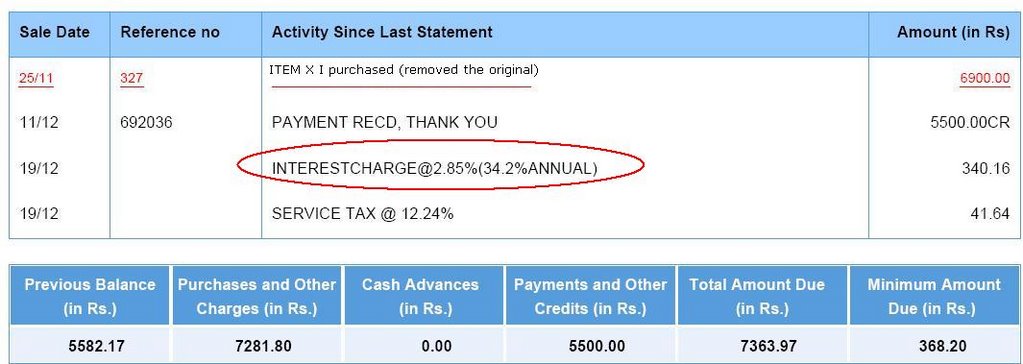
Now see the calculation of how the "interest" is calculate. I had outstanding balance of 5582 Rs in the previous month. Essentially this means I borrowed the 5582 Rs from citibank for one month. And on 25 Nov I again borrowed 6900 Rs for Item X. The due date of payement for 6900Rs is 14 Jan 07 and the due date for paying back Rs 5582 is 6th Dec. The cheque I issued against the previous due got cleared on 11 Dec, which means a delay of 5 days. So essentially they should charge interest for these 5 days.
With interest rate of 34.2% annually, the interest for 5 days should be 0.468%, but they have charged me interest for entire month (34.2/12 = 2.85%)... also they should charge interest only on Rs 5582 which should be Rs 159... but instead they charge intersest on the entire outstanding amount which is 2.85% of (5582 + 6900 Rs) = Rs 340 approx.
This is the way card companies make money. Imagine millions of customer paying such un-necessary amount. That is why credit card division is one of the most profitable business for any bank. This case is not exclusive to Citibank, but all card companies have more or less same terms. I have never shown much interest in knowing the terms and conditions, but now is the time I should look into it carefully.
Check out an interesting (although old, Nov 04) article by Robin Stein titled The Ascendancy of the Credit Card Industry.
Legal but unethical "rounding off"
This article really shows that even a little maths can bring a huge difference. The essence of the article is that the Tempelton Fund is making money by just "rounding off" the percentage entry load (2.25%). This rounding-off is entirely legal since the offer document mentions it, but it really amounts to duping the investor. I do try to read the offer document, but never thought that such tiny clauses are used to make crores of rupees.
Check out this from the article
Masrani applied to its New Fund Offering - the 'Templeton India Equity Income Fund' paying Rs. 1,02,250.00 calculated as Rs. 1,00,000.00 for 10,000 units @ Rs. 10.00 per unit plus the entry load of Rs. 2,250.00 at the rate of 2.25%. He received the fund statement for May 18, 2006, which shows an allotment of 9,995.112 units instead of the 10,000 he had applied for - in effect five units less.
On studying the statement in detail he discovered that the units were priced at Rs 10.23 and NOT Rs 10.225 each, which was supposed to be the cost at 2.25 % entry load to the unit price of Rs 10. A call to the toll free number (1-800-424-4255) fetched a response from Ms. Dimple who clarified that the price had been rounded off to two decimal points and this was mentioned in the offer document.
Now consider this. Masrani has a letter from Franklin Templeton's President Vivek Kudva to unit holders which says that 390,000 investors responded to the Templeton India Equity Income Fund offer and it collected over Rs 2,000 Crore.
At Rs 10 a unit, this breaks down to 200 crore units allotted. Now add Rs 0.005, which was rounded off to the correct price of Rs. 10.225 and it adds up to a whopping difference of Rs. 1 crore.