ICICI hikes service charges

It is a bad news. With everyone seems to be eating up your income, this is another setback to the banking customers. Private banks like ICICI & UTI have decided to increase the charges for services like ATM cash withdrawl & if customers fail to maintain the quarterly balance (Rs 5000). This will be applicable from July 1. ICICI has also increased charges for PIN regeneration and ATM usage of non-partner banks. ICICI Bank customers, who fail to maintain QAB, will now be able to avail of only five free ATM transactions as against the earlier six and thereafter they would be charged Rs 50 per transaction instead of Rs 25 per transaction earlier. According to banks the move is made to penalise customers who do not maintain the necessary balance or issues unnecessary cheques (penalty increased for cheque bounce). Currently there is no fixed guidelines set by RBI for "how much banks can levy such charges?" and usually this is fixed by the competition in the market. With the increase in education cess (3%) and the service tax of 12%, the effective income tax any way has shot up. With small things like ATM transactions now attracting huge fees, customers now have to rethink befire using banking services everytime.

Home Loans Squeezed

In another news, the FM has directed state-run banks to go slow on personal and home loans higher than 20 lakhs. With the rising interest on home loans, it anyway has become extremely difficult for individuals to dream of owning a decent house. So this is definitely a big blow to everyone who wants to own a house. Considering that the home rates are skyrocketing in metro cities like Banglore, Hyderabad and Delhi, dreaming about your own few hundred square feet has become more difficult.

Although the step is taken to curb inflation and ease out industries which are overheating, but I think the limit of 20 lakhs is just a bit low to even filter out average buyer. So the only choice for an aspiring owner is to visit the nearest private bank, which now can muscle around with difficult terms and conditions (which anyway are too convoluted). It looks like bad news all around.

MCX ties up with IIMA

This is a piece of new I read in ET today, I still wonder, are the commodities market so much booming? At least the retail investor is very very far away from it. Here is the news

THE booming commodities market has now caught the fancy of the premier B-school Indian Institute of Management, Ahmedabad. The institute plans to set up a commodities chair in association with the Multi Commodity Exchange of India (MCX). With this, the institute will now increasingly conduct focused research on different commodities, including the demand supply, production and trading patterns.
“We want to encourage good market research on commodities, so we have tied up with IIMA to set up a research chair at the institute,” said Joseph Massey, deputy managing director, MCX.
It is also talking to a few other IIMs for possible collaborations. The commodities market is already catching the fancy of the management schools. The IIMA, which recently held an agri festival ‘Amaethon’, also held commodity trading games as a part of the event this year. Many students from the PGP-ABM (post graduate programme in agri business management) are increasingly opting for careers in the commodities market.
Booming economy, good returns and fast expanding network of commodity exchanges have given momentum to commodities trading market.
The total commodity futures trading volumes in the last financial year have increased to Rs 37 lakh crore from previous year’s Rs 21.55 lakh crore.

Buying First House, Cheers!

THE government is planning to seek long-term loans from multilateral finance institutions like ADB and World Bank to provide credit to Indian housing finance companies at competitive rates. This would enable housing finance companies to provide home loans to customers at a much lower rate. This facility is being considered to provide cheap loans to first time home buyers.

“We are considering a proposal to provide housing finance companies direct access to cheaper credit contracted by the Centre from multilateral institutions for building infrastructure. Though the proposal is at initial stages of discussion, the issue is being pursued seriously to provide relief to home loan segment,” an official of housing ministry told ET.

A proposal from the housing ministry to offer cheaper loans to first-time home buyers is under consideration of the finance ministry. Once approved, the Centre would work out details of loan agreements with multilateral institutions for this specific use, the official said.

The new mechanism is being considered to cool down the cost of finance for the housing sector. If it materialises, the step would come as a major relief to consumers who have seen a spurt in interest rates due to high inflation.

Home loan rates have moved up between 200 percentage points and 300 percentage points since the last one year. The current cost of fixed rate home loans varies between 12% and 14%. The rates under floating option is slightly lower than this. Under the new system, housing finance companies could access funds at a much lower rates of about 5-8%. This would enable them offer home loans at less than market rates even if a premium is charged on funds secured from multilateral agencies.

While the housing ministry is taking forward the proposal, a Planning Commission working group had earlier suggested the same to give a boost to the housing sector.
Via [TOI]

SIP only in month end

I was reading an article in ET about how it is beneficial to go for choosing dates in SIP at the fag end of the month. The idea is that historical data reveals that NAV is always lower during the month end. So if your SIP is timed such that you buy units at the end of the month, you will get the units at lower NAVs compared to other days. The suggestion is to time the buying of units between 23rd to 2nd of next month. This has been corroborated by the following data and the saving can be as high as 3.5%.


I find this advice a bit counter-intutive. If you closely look the % saving is continuously reducing from year 2000 and there is as such no clearcut pattern. Also a retail investor chooses SIP primarily to enforce a disciplined saving. The risk-takers usually don't go SIP route and also those who have lump-sum amount to invest. SIP is particularly popular amongst the salaried people. Now if someone choose the SIP investment date at the fag end, it would most likely be a time when the salaries have been splurged away with all the purchases and expenses. This might lead to another problem of cheque bounce or direct-debt insufficient cash situation. The best time is to make it as soon as your salaries come, this way the money is already gone into saving.

Excel Based Mutual Fund Portfolio Tracker

Here is an excellent tool from Purna Chandra. He explains how to create an excel sheet based mutual fund portfolio tracker. He has generously allowed the excel sheet to be downloaded. Just remember that everytime you open the workbook, go to "NAVs" sheet and refresh the data. [Select anywhere in the table, right click and say Refresh Data].

Happy New Year !!

Welcome to the new year !! I am not talking about the calender year, but the financial year. An average person does not care much about it and why should he? He has already gone through the mind-boggling exercise of arranging income-tax papers and investments etc and now is a time to take a sigh of relief. In India most of us follow the "college habit approach" to investments. I remember during the college days we use to study for the exam only when it looks fast approaching.

Most of us adopt a similar approach while putting their money for investments. And the worst part is that almost everyone looks at investment as a tax-saving avenue. I would expect that if government withdraws tax-advantage out of investment schemes, no-one will want to put their money. This is sad because the goal of personal finance is to optimally use the money you earn during your working life and having a security against all mis-haps in your life. The goal should not only be to save the tax but to iron out the financial ups and downs in one's life.

April is a significant month financially. This is the time when an individual is either flush with year-end arrears credits/claims/reimbursements or in deep financial trouble due to heavy cuts on account of large end-of-year income tax payout.

So here is a short guide to mangae "April Blues" :

1) Start Early : It is easier said than done. As I was writing this I realised that I have to fill a tax-declaration for financial year 07-08 to my employer. Now this can be a good starting point. Take some time out of your busy life and spend on quality discussion with your spouse/family members on how you want to manage you finances this year. There are some investments you are "stuck" with like that insurance policy you took just to fill up the Sec80C quota last year. Think carefully on what you need and what you can manage this year.

2) Identify investments for tax-saving purpose and those for purely investment purpose. Look at the various sections. Here are some major sections for tax-saving

Section 10 & 17 : HRA Exemption, Medical Exemption, LTA Exemption etc
Section 80D : Medical Premiums
Section 80E : Higher Education Loans
Section 80C : LIC, NSC, PPF, Housing Loan, MFs etc etc (an upper limit exists)

Some sections would exist where you already have invested and have a committments like LIC premium or MF SIP route.

3) Make sure you understand the changes in the income-tax sections as announced in the budget. You can either talk to a financial consultant or check out internet for the new laws. For example, the section 80E for higher education loan has been changed which allow you to get higher educaation loan exemption benefit even when the loan is taken by your children or spouse.

4) Once you have the list of you out-goes for tax-saving purpose (which are almost mandatory), think of the inflows thoughout the year and the possible expenditure. Expenditure are of two types : Planned & Unplanned(which can be further divided as Unplanned Necessity and Unplanned Luxury). For example, if you are planning to take a abroad trip or you want to buy a car then plan for it now. These are planned expenditure. You can even put money into short-term investment options to offset any inflation or any excess in the estimated price. When you spend on impulse buying like you went to a mall and instantly liked a new mobile phone, you just go ahead and use that plastic money (a.k.a credit card), that is an unplanned luxury expenditure. Make sure you put brakes on such unplanned expenditure by having an upper limit on it and sticking to it.

I put brakes on such an unplanned luxury expenditure by following rules:
a) Spend all luxury expenses through credit-card
b) Fix an upper limit of maximum one-month salary
c) If we are about to reach that limit, then stow away all credit cards/debit cards into a locker at home. If you dont have the card handy, you cannt be impuslive in buying. Sometimes its inconvinient but thats the price I pay for splurging on other times :-)

You should also reserve some cash for contingencies like accidents or illness. That would be Unplanned Necessity.

5) Once you have chalked out your in-flows and out-flows, then you can easily know how much extra money you have. Some part of this now can be put into long-term options specifically tailored for investment purpose and not for tax-saving.

It looks like a lot of headache to plan, but once you do it, you will rest in peace (of mind that is)!!

PPF with ICICI !!

I realised that banking experience in India is still a long way to go. I had a PPF account opened with SBI in Noida but I could not contribute much to it. When I wanted to shift the correspondance address on the PPF account to my current hyderabad account, I was told that I need to transfer the account to a hyderabad SBI branch which took almost like two-three months. Now I have again shifted out of hyderabad and does not have patience to shift the account again. I wondered why no private bank offers a PPF account facility with a direct debt from saving account. This ensures a speedy and hassle-free saving to any PPF account. This also automatically puts a regular saving discipline.

After searching a bit I found that ICICI bank is authorised(PDF) is authorised by Ministry of Fianance to collect PPF money in select branches. So when I went to one of the local branch, the person there bluntly told me that we dont open PPF accounts. He told us to visit some other branch. When we went to one of the main branch in the locality, there also the story is repeated. We had to forced them to talk to the manager, who finally accepted that a circular has come but no one till now has asked us to open a PPF account. After a lot of argument and pain, I finally managed to open an account for my wife. But again we didnt got the direct debt facility.

Survival Guide on how to manage financial documents?

As the number of your service years grows and with marriage and other family responsiblities, everyone faces the problem of properly managing various documents (mainly financial) since these keep on growing. Noone is sure of when one will need which document. I am also slowly facing the same situation, the documents are piling up and I don't have a full-proof method for storing them.

So what are the requirements for managing documents:

a) An effective classification method
b) A fire/flood/theft proof method
c) Easy to access when needed
d) Easy to add/subtract documents when needed

I was trying to find some methods people use and came across The Noguchi Filing System or Neat Receipts or using softwares like Quicken, M$ Money or some people use the traditional shoe-box method.

The biggest problem with me is that I am never sure of which doument to keep until which time, while led me to keep everything forever. This leads to huge pile-up of documents which becomes really really un-manageable.

I have not came across any Indian government guidelines on how long to keep financial documents, similar to what US-government (IRS) suggests.

A few guidelines can be useful though

  • Keep all the tax-related records for atleast ten years.
  • Keep quarterly retirement/savings plan statements until you receive an annual
  • statement. If the numbers match, shred the quarterlies and keep the annual summaries permanently.
  • Keep the important bank records for atleast five years; shred unimportant documents immediately.
  • Keep brokerage statements until you sell the securities.
  • Most of the time you can shred bills once you get a cancelled check. Keep bills for big items permanently. Keep the bills if it involves a warranty period.
  • Keep credit card receipts till it matches with your statements, then keep the statements for five years.
  • PaySlips should be kept until you receive your Form-16 at year end.
  • Keep house records permanently.

Remember: If possible, shred all financial documents when you get rid of them.

This is just a vauge guideline and individual discretion is solicited.

Tax Guide For First Timers


I remember the day, some few years back when I got a mail from my employer about submission of income tax-proofs. It got me into tizzy since that was the first time I had come under this process. A fresh graduate on landing a good job had never thought that goverment will play spoil-sport to him at the end of financial year.

With India shining, employement is rising and so is the entry level income. This is typically true of IT, ITeS industry where income level are sufficiently high for fresh graduates to seriously considering income-tax investments.

A first timer (I am only taking about service class first timers) should keep following things in mind:

1) Income tax calculation is NOT rocket science. A careful thought and study can easily unravel the mystry.
2) Do not make any un-informed decisions while saving for income-tax.
3) Usually employers deduct a portion of your income towards the tax every month. This is a good thing since this makes sure that you are not loaded with the entire income-tax at the end of year.
4) If your employer does not deduct any income-tax (which is extremely unlikely) then he is not showing you as a regular employee of the company on its payroll. Just confirm it.
5) Income tax rules change every year, so you should be aware of the latest rules for current financial year.

Some terminology which will be helpful for first timers:

Calender Year: January to December

Financial Year: April to March (currently income tax follows this cycle)

Income Tax: An amount of your income that goes to governement (what it does with that money is open to debate)

Tax Liability: The amount of tax you are liable to pay to government.

PAN : Permanent Account Number (PAN) is a ten-digit alphanumeric number, issued in the form of a laminated card, by the Income Tax Department. It is mandatory to quote PAN on return of income, all correspondence with any income tax authority.

Salaried Individual: You (this only includes your income)

Form-16: A form provided by your employer after all tax-calculation. This is the form that needs to be submitted to the goverment. It essentially tells what amoung of income you got and what amount of tax the employer cut and if there is any pending tax-liability.

Provident Fund: A fund set aside by government where an employer has to put certain portion of your income into it. Usually a same amount is put by employer on your behalf. So if 2000 INR is cut from your income and put into PF, then another 2000 INR is put by employer in your name into the PF. All the money in the fund belongs to you but only when you retire. So essentially government is making sure that even if act carelessely throughout your life without saving a single penny, you will have some amount of money in your PF account post retirement.If an employer makes you sign a declaration that you do not want a PF, do not sign it. Ask your employer that you need the PF.

Exemption: A tax-exemption implies that certain part of your income can be exempted based on certain criterion or if you spend your income on certain things (e.g. charity), you wont have to pay tax on the money you spent.

Deduction: If you put your money into some schemes or for some specific purposes, then you get a deduction

The main difference between 'exemption' and 'deduction' is that exemption is taken out before your gross taxable income is calculated, while deduction is reduce from gross taxable income to get the net taxable income.

Gross Taxable Income : This essentially is the amount you earned in this financial year.

Net Taxable Income: This essentially is the amount of your gross earnings that will be subjected to tax.


Income tax calculation is very easy, the confusion occurs because different people have different needs and different cases.

The indian income tax follows a progressive tax structure. The laws are made by Finance Ministry and modifications are made usually every year. The current tax-slabs are as follows:

Few important things to remmeber

a) There are various sections of Income Tax Act, few of which are important to know before you plan your income-tax saving.

b) The idea of providing income-tax deductions by the government is to increase the saving habits of an individual.

c) Investing for income-tax saving should not be confused with your other financial goals.

When you join a company, it usually asks you to fill "investment declaration". This is nothing but a declaration from you about how much investing/expenses you will be doing throughtout the financial year which can be accounted for tax-deductions or tax-exemptions. This declaration is just an estimate and has nothing to do with your final tax-investments. But it is usually best to be as close as possible to your actual investments. This is because all throughout the year your tax-deduction at source by the employer is done on this basis.

Around the timeframe of Dec-Jan, your employer will ask for actual proofs of investments for tax-calculation. This is the time-frame which is important, since in the coming Feb-March your income tax will be cut based on what proofs you submit. So if you fail to proivde any proof in this timeframe, your employer will cut taxes based on the fact that you have not done any investment (implying higher tax cut). In such a case, if you do invest in Feb-March, which is still in the current financial year, you will not benefit since the tax will already be cut. Although you will get your money back from IT department but that is a long-drawn process.

Then around March-June, your employer will give you a Form-16, which you need to submit to IT department. Once the Form-16 has reached you, your employer's responsiblity is over and now its time for you to submit it. If you loose it or are unable to submit, you will face penalty.

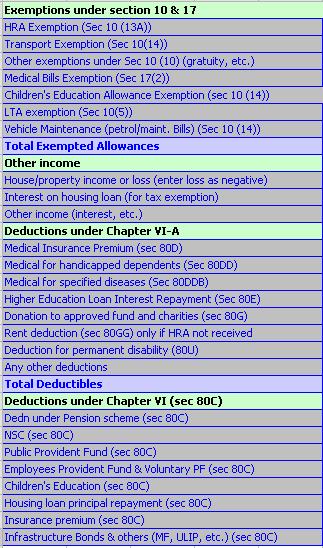
Some important sections under the current Income Tax Act for year April 2006- March2007 are as follows:

(Pic taken from the excel sheet by http://www.ynithya.com/taxcalc)

The most important for you would be :

a) HRA exemption: Your salary would have a component called HRA or House Rent Allowance. If you stay in a rented house, then you can avail this exemption. The formula is quite complicated

HRA Exemption = minimum of { 40% (50% in metro) of Basic+DA OR
HRA OR
rent paid - 10% of Basic +DA}

In most cities, the house owner refuses to give any receipt of the rent, then most people make fake receipts. Try to avoid such situations as far as possible.

b) Higher Education Loan Interest Payment Sec 80E : If you have taken education loan for higher studies, the EMI you pay consist of paying back prinicpal and interest. The amount of interest you paid in this financial year can be used as deduction under this section. Beware that just the interest repayment and not prinicpal repayment can be deducted.

c) Section 80C deduction : To increase saving from individuals, govt has decided to have a upper limit of 1 lakh INR investment under this section to be deducted from gross taxable income. Every scheme under this section (see list above) has pros and cons, so choose wisely. The following table will help you guide which investment has tax-benefit. The major change that has been introduced is that the interest/dividend generated from some schemes have become taxable making such schemes less attractive.


MIN is meaningless

It seems that government agencies work mindlessly. Check out this news about introduction of MIN (Mutual Fund Identification Number).

Investors putting in 50,000 rupees or more in a mutual fund from Jan. 1, 2007 will have to provide a mutual fund identification number (MIN) or apply for one, the Association of Mutual Funds in India (AMFI) said on Wednesday.


The idea of MIN is that "investors dont have to fill forms everytime they invest in various MF schemes and just quoting MIN is enough". On the first appearance it seems like a good step by AMFI to reduce paperwork and ease the investment process. Currently the MFs have to follow the Know Your Customer (KYC) norms which mandates them to ask for photographs, address proof and identification proof like passport or PAN. So the once a MIN is established, any investment in MF in any scheme can be done by just quoting MIN.

But I feel that it will just add more headache in allocating and maintaining the MINs. All investors usually provide a PAN number which is fast becoming synonymous with the social security number of developed countries (at least in terms of financial transactions). The PAN is obtained after proper identification of an individual after submission of photographs, residence proof and other such details. So I fail to understand what extra is achieved by introducing MIN. All major banking transactions need PAN number, any income tax details need PAN number, so I think all transactions can be cross-verified and checked using PAN alone. I feel that quoting a PAN number should be good enough to identify a person.

How Credit Card Companies make money !!

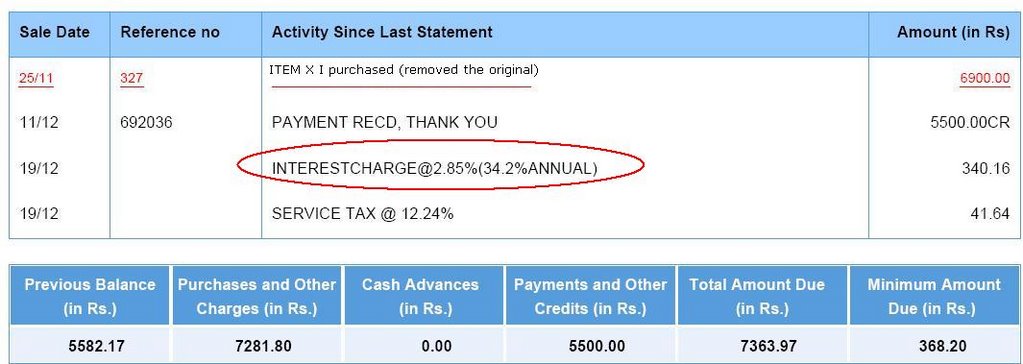
Sometime back I had written this post as to why I dont like Credit Card. I recently recevied the credit card statement from Citibank. I never bothered to look at the "terms and conditions", but this is what my statement looked like:


Now see the calculation of how the "interest" is calculate. I had outstanding balance of 5582 Rs in the previous month. Essentially this means I borrowed the 5582 Rs from citibank for one month. And on 25 Nov I again borrowed 6900 Rs for Item X. The due date of payement for 6900Rs is 14 Jan 07 and the due date for paying back Rs 5582 is 6th Dec. The cheque I issued against the previous due got cleared on 11 Dec, which means a delay of 5 days. So essentially they should charge interest for these 5 days.

With interest rate of 34.2% annually, the interest for 5 days should be 0.468%, but they have charged me interest for entire month (34.2/12 = 2.85%)... also they should charge interest only on Rs 5582 which should be Rs 159... but instead they charge intersest on the entire outstanding amount which is 2.85% of (5582 + 6900 Rs) = Rs 340 approx.

This is the way card companies make money. Imagine millions of customer paying such un-necessary amount. That is why credit card division is one of the most profitable business for any bank. This case is not exclusive to Citibank, but all card companies have more or less same terms. I have never shown much interest in knowing the terms and conditions, but now is the time I should look into it carefully.

Check out an interesting (although old, Nov 04) article by Robin Stein titled The Ascendancy of the Credit Card Industry.

Evil is the root of all money

I was reading this fantastic paper by Nobuhiro Kiyotaki ,London School of Economics and John Moore Edinburgh University and London School of Economics. Their theory tries to answer the question "Why we do have money?". The essence of the argument is that we need money simply because we do not trust each other. In an ideal world, I would say get the service of someone (e.g doctor) and promise him to pay back by something I do when he needs it. But the doctor does not trust me, so I pay him with rupee notes. A money note is essentially a promise by the central bank. So if I pay the doctor 100 Rs, the doctor essentially has got a promise that when he needs something he can trade this 100Rs to get the service/commodity. A central bank is more credible entity for a doctor than me. This argument applies to everyone. A pretty interesting read !!

Legal but unethical "rounding off"

I usually like the solutions posted by Sucheta Dalal on Money Life. Now check out this absolutely amazing and shocking trick used by Tempelton Mutual Fund (One of the most respected MF in India).

This article really shows that even a little maths can bring a huge difference. The essence of the article is that the Tempelton Fund is making money by just "rounding off" the percentage entry load (2.25%). This rounding-off is entirely legal since the offer document mentions it, but it really amounts to duping the investor. I do try to read the offer document, but never thought that such tiny clauses are used to make crores of rupees.

Check out this from the article

Masrani applied to its New Fund Offering - the 'Templeton India Equity Income Fund' paying Rs. 1,02,250.00 calculated as Rs. 1,00,000.00 for 10,000 units @ Rs. 10.00 per unit plus the entry load of Rs. 2,250.00 at the rate of 2.25%. He received the fund statement for May 18, 2006, which shows an allotment of 9,995.112 units instead of the 10,000 he had applied for - in effect five units less.
On studying the statement in detail he discovered that the units were priced at Rs 10.23 and NOT Rs 10.225 each, which was supposed to be the cost at 2.25 % entry load to the unit price of Rs 10. A call to the toll free number (1-800-424-4255) fetched a response from Ms. Dimple who clarified that the price had been rounded off to two decimal points and this was mentioned in the offer document.
Now consider this. Masrani has a letter from Franklin Templeton's President Vivek Kudva to unit holders which says that 390,000 investors responded to the Templeton India Equity Income Fund offer and it collected over Rs 2,000 Crore.
At Rs 10 a unit, this breaks down to 200 crore units allotted. Now add Rs 0.005, which was rounded off to the correct price of Rs. 10.225 and it adds up to a whopping difference of Rs. 1 crore.

Investing Fundas Revisited

I was just reading this article at seekingalpha website and found

Peter Lynch, former manager of the Fidelity Magellan Fund says in this article :
You’re already highly exposed to your job - after all, it’s your job that pays your salary and probably your retirement contributions and health insurance. The last thing you want to do is to increase your financial exposure to the industry you work in or its suppliers or customers.

I saw this clearly in my job as a research analyst covering the communications equipment sector during the boom and bust of 1998 to 2002. Many of my industry contacts were intelligent and sophisticated people who saw that demand for their firms' products was strong, and in some cases realized that their own company (or a competitor) was gaining market share. So they mistakenly bought stocks in their own sector. When the market for communications equipment subsequently collapsed to the surprise of most people in the industry, many of them lost not only their jobs, retirement contributions, health insurance and other benefits, but also took a severe hit to their investment portfolios.

So in theory, instead of buying stocks based on your work knowledge, what you actually want to do is to hedge your exposure to the industry you work in.

This echoes with what I wrote earlier.

Economic Times Releases a MF CD


I just looked at this advertisement in Economic Times. Will this CD offer something different? or will it be just the same old views about Mutual Funds in India. After reading so many blogs and so many magazines, I feel that most of them offer same old "ghisa-pita" suggestions.

Buying Gold

I recently read an article from Personalfn.com about not buying gold from banks. I liked the article, since I was too thinking about it. Gold has been a standard and safe investment option from many many years. But there are many problems involved in buying gold. As the article mentions about issues regarding buying gold from bank, but I am even wary of buying gold from anyone else. How much can I trust a "Branded Retailer" or "Jweller". This is ofcourse true that a jweller or a retailer can provide a handsome variation in cost while purchasing gold, but what about the quality. Ofcourse now-a-days most of the retailers does provide some kind of certification. But its again a question of what kind of certification.

Another problem I have in buying gold is where to keep it safe? Ofcousre it is unsafe to keep it in the house. So one will think about taking a locker in a bank. But getting a locker is no easy process. There are lot of forms to be filled and one needs a account with the bank. Also most banks want some deposit to be placed in the account before they can open a locker and the deposit is something like 10,000 Rs. Also if you shift from one place to other, you need to close the locker in a specific branch and reopen it (going through the same cumbersome procedure). It is a real pain. How about following changes ?

-- The banks should re-purchase the gold if kept in the same condition (e.g bars or coins)
-- This re-purchase should be valid across all the banks. So a gold coin purchased from one bank can easily be repurchased by any other bank.
-- A device (as small as say mobile) to quickly identify the purity of gold. It can be extremely useful while purchasing gold.
-- A concept of dematerialised gold (similar to dematerialised stocks). So I log on to the bank website, purchase gold say 500gm using direct debit from my saving account, and instantly my account shows (500 coins, 1 gm each). If I want to re-deem the dematerised-gold, i go to the bank and get the 500 gold coins which I can use to say make a jwellery.

I am back

After a long time, I am back again. The sensex has crossed 14000 mark. Everyone is euphoric and some are extremely cautious. I dont know what to expect next, a sensex touching 15000 or a huge slump. Whatever the sensex indicates, but the economy is going great guns, progressing at an amazing speed of abouve 9%. Shabash India !! Lets hope the dream run continues.


Just testing the "Performancing" add-on in Firefox. I love firefox, but the FF2 is giving me a lot of trouble, so I just shifted back to 1.5.

Difference between APR and APY

APR is the annual rate of interest without taking into account the compounding of interest within that year. Alternatively, APY does take into account the effects of intra-year compounding. Here is a look at the formulas for each method:


For example, a credit card company might charge 1% interest each month; therefore the APR would equal 12% (1% x 12 months = 12%). This differs from APY, which takes into account compound interest. The APY for a 1% rate of interest compounded monthly would be [(1 + 0.01)^12 – 1= 12.68%] 12.68% a year. If you only carry a balance on your credit card for one month's period you will be charged the equivalent yearly rate of 12%. However if you carry that balance for the year, your effective interest rate becomes 12.68% as a result of the compounding each month.

The Borrower's Perspective
As a borrower, you are always searching for the lowest possible rate. When looking at the difference between APR and APY, you need to be worried about how a loan might be "disguised" as a lower rate than it really is.

Banks will often quote you the Annual Percentage Rate (APR). This figure does not take into account any intra-year compounding either semi-annual (every six months), quarterly (every three months), or monthly (12 times per year) compounding of the loan. The APR is simply the periodic rate of interest multiplied by the number of periods in the year.


As you can see, even though a bank may have quoted you a rate of 5%, 7%, or 9% depending on the frequency of compounding (this may differ depending on the bank, state, country, etc), you could actually pay a much higher rate. In the case of a bank quoting an APR of 9%, this does not consider the effects of compounding. However, if you were to consider the effects of monthly compounding, as APY does, you will pay 0.38% more on your loan each year - a significant amount when you are amortizing your loan over a 25- or 30-year period.

The Lender's Perspective

Now as you may have already guessed, it is not hard to see how standing on the other side of the lending tree can affect your results in an equally significant fashion, and how banks and other institutions will often entice individuals by quoting APY. Just as individuals who are seeking loans want to pay the lowest possible rate of interest, the same individual wants to receive the highest rate of interest when they themselves are the lender.

Investing Fundas

The first thing when "investing" comes to mind is saving money for future. This is not true now-a-days when investing truly means maximizing your net returns. One of the important factors while maximizing returns is to reduce the fees and taxes, which many investors ignore.
Yesterday I was chatting with my brother and he wanted to invest in some ESPP, which is nothing but a option to invest in shares of the company you work for. I strongly advised him not to do so. One of the reasons (out of several ones) I feel is that an investor should not invest in the industry they themselves are working. So if I am working in IT, then my portfolio should not consists of many IT shares. Some people might say that then it is advantageous to invest in shares of your own industry since you know it pretty well. This knowledge will help you pick the rock solid shares with ease. My argument is a bit pessimistic. If you work in the same industry where your investments are, chances are that with a sudden downturn or slowdown, not only affects your job but also your investments. Imagine IT people having IT shares during the 2000 dotcom bust. They would have lost not only their jobs, but their savings too !!

LIC backed by government


A recent news in the Economic Times, mention that governemnt has decided to continue backing up the LIC policies. A gurarantee by government implies a liability which must be mentioned somewhere in the finances of the government. I think, gone are the days when people used to subscribe policies based on whether these are backed by government or not. The IRDA already have stringent policies for all insurance players, private or public. Anyway here is the entire article:


THE 16 crore policyholders of the Life Insurance Corporation (LIC), can heave a sigh of relief with the government planning to continue with its guarantee for these policies. Fearing value erosion if the sovereign cover is withdrawn, the government has decided against discontinuing it.
“Too much is at stake, we are not withdrawing the guarantee,” sources said. At present, the government guarantees the payment of the sum assured and the bonuses on all LIC policies. Withdrawing the guarantee was debated by the finance ministry for some time. This was after the insurance regulator recommended a withdrawal of its sovereign guarantee on the LIC policies to ensure a level-playing field vis-a-vis private players. The latter does not enjoy such covers.
Extending sovereign guarantee to LIC does not have a direct bearing on the fiscal deficit, it adds to the fiscal pressure of the government since it is classified under contingent liability.
The government is currently reviewing the 1956, LIC Act. It plans to amendment the Act by the end of this year. Though a government guarantee has existed since 1956, there had been no cause for invoking the guarantee. The state insurer has a share capital of only Rs 5 crore, but has managed to remain in business on the strength of the sovereign guarantees backing its commitments.
While trying to restructure LIC a couple of years ago, Deloitte & Touche Tohmatsu India, the consultant hired by the insurer, had said the government guarantee is quasi equity, which should be replaced with actual equity. But experts see no argument in this condition.
Experts feel that while it may not be legally possible to withdraw the guarantee on policies that have been already issued, the government can withdraw its cover on future policies.
Also linked to the amendment of the LIC Act is a plan to enable the company to set up separate reserves for solvency margin at par with private insurers.
Under the LIC Act, 95% of the surplus earned goes to the policy holders and 5% to the government as dividends.
The surplus does not go to the corporation. Amendments to the LIC Act will also enable LIC to raise its paid-up capital from Rs 5 crore to Rs 100 crore, as in the case of private insurers.